How does community-led monitoring accelerate overcoming the HIV epidemic in EECA countries? Experience and plans of 3 countries: Kazakhstan, Kyrgyzstan and Tajikistan
Eastern Europe and Central Asia (hereinafter – EECA) is one of the global leading regions regarding HIV with negative trends:
- rapidly increasing dynamics of HIV incidence (49% increase since 2010),
- the number of AIDS-related deaths is also increasing (46% more than in 2010),
- at the same time, it has one of the lowest coverage rates of HIV prevention and treatment services (only 51% of PLHIV receive ART),
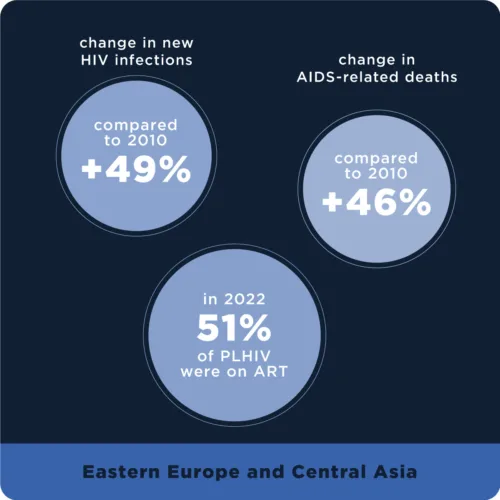
- and treatment cascade rates were only 62%-51%-48% last year,
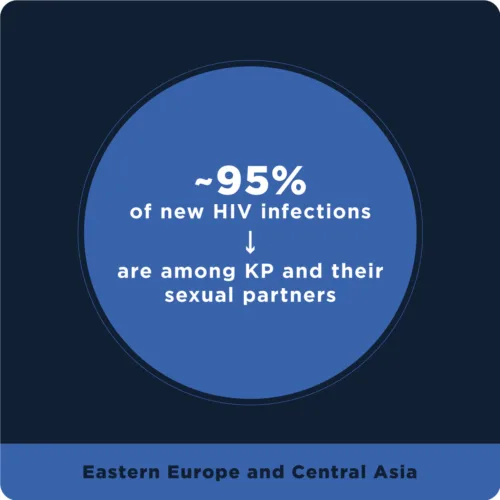
- while more than 95% of new infections are registered among key populations and their sexual partners.
HOW DOES THIS FIT INTO THE BROADER CONTEXT?
A number of factors exacerbate the situation in the EECA region and hinder effective HIV responses:
- a complex legal environment,
- growing inequalities,
- numerous human rights violations,
- as well as a number of socio-economic changes, including those caused by the war in Ukraine.
Central Asia is increasingly becoming both a destination and a ‘donor’ for migrants – especially as they move to and from the Russian Federation. As destination countries, they face the challenge of integrating incoming migrants, and as countries of origin, they face the consequences of deteriorating living conditions of their citizens abroad (who in some cases become return migrants in need of reintegration and re-socialisation).
These challenges have increased the already inadequate domestic funding for HIV initiatives in the region. The lack of funding has limited local investment accordingly, and the shrinking opportunities for community engagement have emphasised the urgent need for increased financial support to respond to the HIV epidemic in the region. This all points to an urgent need for improved strategies and interventions.
In addition, these factors reduce the availability of services for beneficiaries of HIV-associated programmes, and increase the risk of new infections. Migration and socio-economic disadvantage make certain groups more vulnerable to HIV, stigma, access to health care – and therefore more likely to engage in risky behaviours: due to reduced social support and resources.
Weakened capacity of key population organisations also makes it more difficult to collect and report HIV data, creating data gaps and hindering effective resource allocation and epidemic trac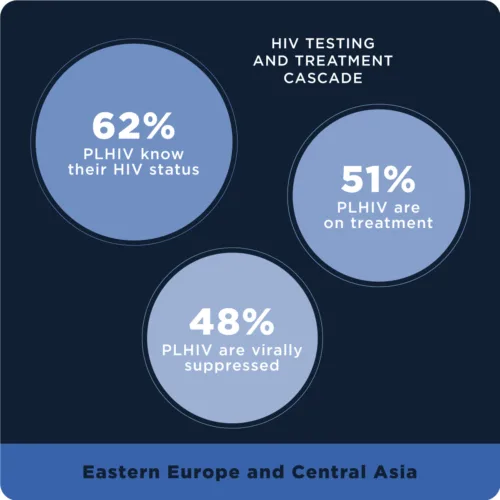 king. Against the backdrop of these challenges, CLM (Community-Led Monitoring) plays a critical role in identifying and addressing gaps in HIV service delivery. This tool provides direct feedback from affected communities on specific issues such as access to health care, supply chain disruptions and barriers to service utilisation.
WHAT CAN INFLUENCE THIS SITUATION QUALITATIVELY AND PROMPTLY?
For more than 2 years our team has been working in the EECA region to increase the capacity of organisations led by representatives of key HIV vulnerable communities to conduct monitoring of health and social programmes. This was made possible through the project ‘Strengthening Community Engagement and Capacity for Community-Led Monitoring in Eastern Europe and Central Asia’ funded by the US Centers for Disease Control and Prevention (CDC) under a cooperative agreement with UNAIDS.
At the heart of CLM is the ‘nothing about us without us’ approach to data – which provides a valuable opportunity not only to internally assess the quality of services and barriers to access, but also to build a sustainable and unique evidence base for further community advocacy. This in turn influences decisions about which needs are important to allocate resources to in the first place.
“We believe that such an initiative will help tens of thousands of specific clients in our country to receive, in the near future, services that are focused precisely on their needs, comfort, and improving their quality of life. And when I speak of the near future, I am not talking about decades.
What gives us confidence in the reality of the goal? First of all, we will maximally test the developed tools for data collection in the ‘field’ to select the most effective one. An important step will also be the creation and functioning of the CLM country platform (community council + country expert group under the interagency working group on overcoming legal barriers). This will be followed by efforts to popularise the developed tool among all stakeholders. And finally, the last but very important step is to send the results of the MRS to the Cabinet of Ministers and the Ministry of Health. The sum of these actions will defi nitely lead to success”, – Nurali Amanzholov shares his vision, president Central Asian Association of People Living with HIV (project partner from the Republic of Kazakhstan).
WHAT WAS IT LIKE BEFORE?
For many years, community representatives were involved in data collection only at the field stage, while ‘expert organisations’ had the authority to determine the focus of data collection, terminology and collection tools. What is important for the HAC and our partners is for communities to independently monitor, initiate advocacy, and then coordinate the implementation of changes at different levels.
WHAT IS REALISTICALLY ACHIEVABLE IN 2024?
The ultimate goal of all these activities is to improve programmes and services for people living with HIV and key populations, who are in fact the main beneficiaries of support. Sergei Dmitriev, Executive Director of HAC, points to the indicators that measure the project’s substantive effectiveness:
1️⃣ ‘Firstly, it is important to have a successful piloting experience. Because it will definitely get support from other donors and will allow scaling up to more regions in the countries.
2️⃣ Secondly, there will definitely be concrete changes in national HIV programmes that are needed right now. This is about both government and donor initiatives.
3️⃣ And thirdly, correcting the difficulties identified by the monitoring will help to build political consensus among government partners in these countries. This in turn will help to initiate a dialogue on further integration of community-led monitoring data into national HIV programmes.
WHICH COUNTRIES ARE COVERED AND WHY?
The project activities focus on three Central Asian countries: Kazakhstan, Kyrgyzstan and Tajikistan. The initial selection of countries was made based on the level of development of CDM (where there are various CDM activities, but they are random, unsystematised and unsustainable), the current context of the countries, available and under consideration CDM models already implemented in other countries of the region through other sources of funding.
“‘Counting on a fairly simple and at the same time absolutely uncompromising ambition for us:
- Developed and piloted an optimal CLM data collection toolkit that is inherently comprehensive and universal – so that all communities can use it,
- Overall coordination of all activities in the country in the field of CLM,
- Communities will become leaders in the CLM,
- Introduce community monitoring into the ‘routine’ work of NGOs that work with community representatives (and PLHIV),
- On the basis of a multidisciplinary working group, a unified national platform on CLM will work,
- The results of the MDS will be accepted by the government to improve service delivery,
- CLM will become an independent mechanism that does not require additional funding.
Judging from the experience of other countries, there is confidence that community monitoring can indeed catalyse the necessary processes, change systems, and reform approaches”, – convinced Aybar Sultangaziev – Head of Associations ‘Partner Network’ (project partner from the Republic of Kyrgyzstan).
WHAT IS AT STAKE?
Sergey Dmitriev names the following components to guarantee the success of the programme:
➕ Proactive involvement of key affected communities in the monitoring process. It is important to have an active position, openness to the development of monitoring practices, readiness to immediately advocate for changes in existing programmes on the monitored problems.
➕Partnerships. Since the pilot projects concentrate advocacy work and negotiations with like-minded organisations on developed platforms in the format of national multisectoral working groups to coordinate the MDGs.
➕MRS cannot be seen as a one-off event – it is a cycle of action monitoring>analysis>advocacy>changing identified problems. This integrated approach and having the full cycle in one project will not only allow for the development of country-specific LDC practices, but also for relevant changes in national programmes.
" class="term-name-badge badge badge--light inline-block border border-gray-300 cursor-pointer">
Warning: Attempt to read property "name" on array in /home/hac2023/hac.health/old/wp-content/themes/hac_theme/template-parts/content-news.php on line 35
/home/hac2023/hac.health/old/wp-content/themes/hac_theme/template-parts/content-news.php on line 35
" class="term-name-badge badge badge--light inline-block border border-gray-300 cursor-pointer">
Warning: Attempt to read property "name" on array in /home/hac2023/hac.health/old/wp-content/themes/hac_theme/template-parts/content-news.php on line 35
" class="term-name-badge badge badge--light inline-block border border-gray-300 cursor-pointer">
Warning: Attempt to read property "name" on array in /home/hac2023/hac.health/old/wp-content/themes/hac_theme/template-parts/content-news.php on line 48
/home/hac2023/hac.health/old/wp-content/themes/hac_theme/template-parts/content-news.php on line 48
" class="term-name-badge badge badge--light inline-block border border-gray-300 cursor-pointer">
Warning: Attempt to read property "name" on array in /home/hac2023/hac.health/old/wp-content/themes/hac_theme/template-parts/content-news.php on line 48
Related news
Warning: Attempt to read property "name" on array in /home/hac2023/hac.health/old/wp-content/themes/hac_theme/template-parts/components/component-news-article.php on line 23
Warning: Attempt to read property "name" on array in /home/hac2023/hac.health/old/wp-content/themes/hac_theme/template-parts/components/component-news-article.php on line 23
Jul 30 2 min read
AIDS 2024: Nineteen Key Insights from the 25th International AIDS Conference
Warning: Attempt to read property "name" on array in /home/hac2023/hac.health/old/wp-content/themes/hac_theme/template-parts/components/component-news-article.php on line 53
Warning: Attempt to read property "name" on array in /home/hac2023/hac.health/old/wp-content/themes/hac_theme/template-parts/components/component-news-article.php on line 53
Jul 30

Warning: Attempt to read property "name" on array in /home/hac2023/hac.health/old/wp-content/themes/hac_theme/template-parts/components/component-news-article.php on line 23
Warning: Attempt to read property "name" on array in /home/hac2023/hac.health/old/wp-content/themes/hac_theme/template-parts/components/component-news-article.php on line 23
Jul 26 2 min read
AIDS 2024: 5 insights towards improving access and optimizing the range and costs of HIV testing globally
Warning: Attempt to read property "name" on array in /home/hac2023/hac.health/old/wp-content/themes/hac_theme/template-parts/components/component-news-article.php on line 53
Warning: Attempt to read property "name" on array in /home/hac2023/hac.health/old/wp-content/themes/hac_theme/template-parts/components/component-news-article.php on line 53
Jul 26

Warning: Attempt to read property "name" on array in /home/hac2023/hac.health/old/wp-content/themes/hac_theme/template-parts/components/component-news-article.php on line 23
Warning: Attempt to read property "name" on array in /home/hac2023/hac.health/old/wp-content/themes/hac_theme/template-parts/components/component-news-article.php on line 23
Jul 25 2 min read
AIDS 2024: 7 insights regarding institutionalization and integration of CLM in the EECA region
Warning: Attempt to read property "name" on array in /home/hac2023/hac.health/old/wp-content/themes/hac_theme/template-parts/components/component-news-article.php on line 53
Warning: Attempt to read property "name" on array in /home/hac2023/hac.health/old/wp-content/themes/hac_theme/template-parts/components/component-news-article.php on line 53
Jul 25

Warning: Attempt to read property "name" on array in /home/hac2023/hac.health/old/wp-content/themes/hac_theme/template-parts/components/component-news-article.php on line 23
Warning: Attempt to read property "name" on array in /home/hac2023/hac.health/old/wp-content/themes/hac_theme/template-parts/components/component-news-article.php on line 23
Jul 24 3 min read
AIDS 2024: 7 insights on decentralization of HIV-associated services in EECA
Warning: Attempt to read property "name" on array in /home/hac2023/hac.health/old/wp-content/themes/hac_theme/template-parts/components/component-news-article.php on line 53
Warning: Attempt to read property "name" on array in /home/hac2023/hac.health/old/wp-content/themes/hac_theme/template-parts/components/component-news-article.php on line 53
Jul 24
